
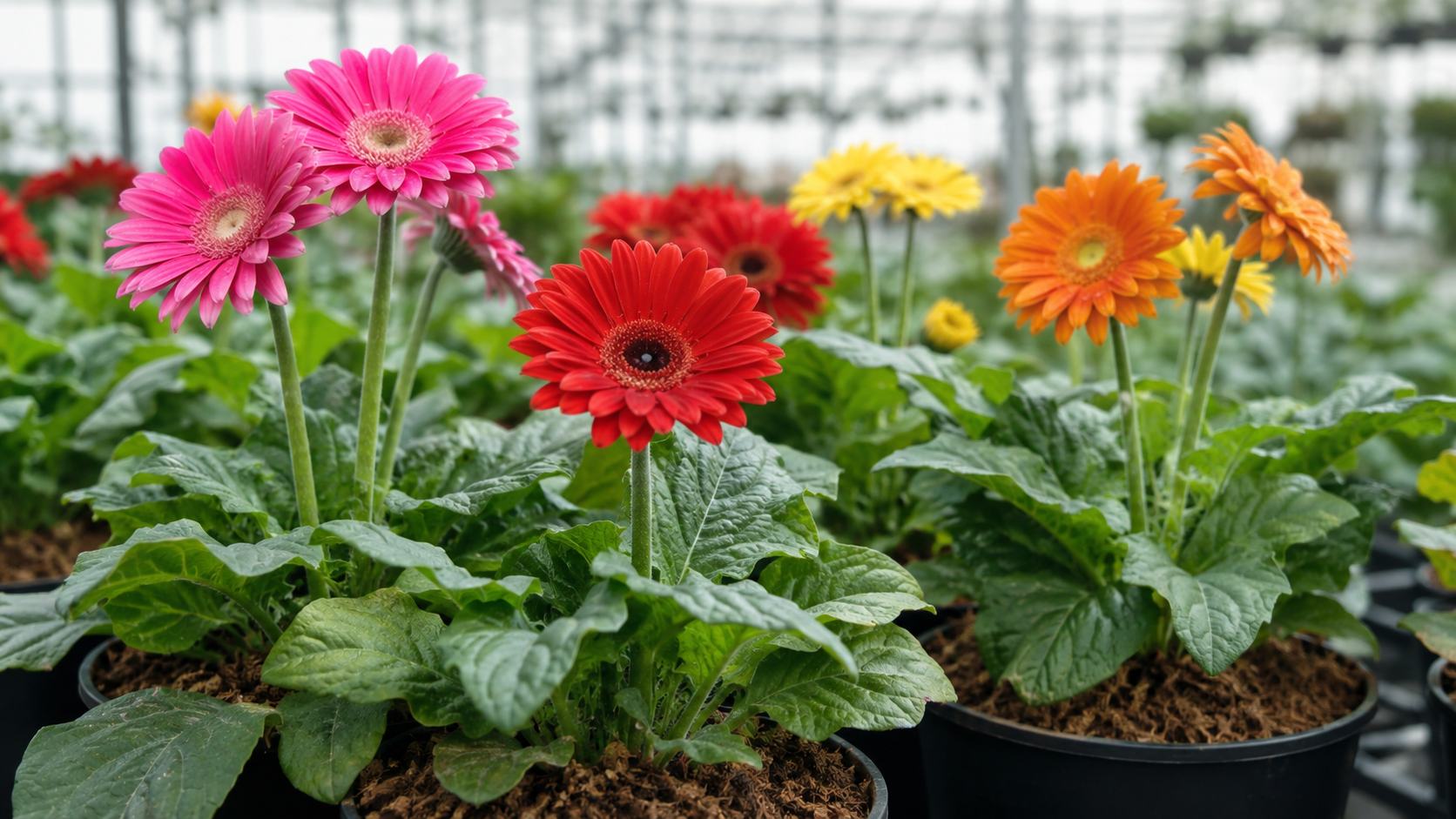
Perder plantas de gerbera por pudrición radicular es caro y desmoralizante. En la mayoría de los casos, la raíz del problema —literalmente— está en el equilibrio aire/agua del sustrato. Losing gerbera plants to root rot is costly and demoralizing. In most cases, the root of the problem —literally— lies in the substrate's air/water balance.
La gerbera es un cultivo de alto valor y poca tolerancia al error. Una de las pérdidas más frecuentes —y más evitables— en su producción es la pudrición de raíz: la planta se marchita, la corona se ablanda y, cuando se nota, suele ser demasiado tarde para esa unidad.
El problema: exceso de agua en la zona radicular
La pudrición radicular suele atribuirse a un patógeno (Phytophthora, Pythium), y es cierto que esos organismos pueden ser los agentes causales. Pero el patógeno puede prosperar cuando la zona radicular permanece saturada y con poco oxígeno. Un sustrato que retiene demasiada agua y aporta poca aireación favorece condiciones para el desarrollo de la enfermedad.
En floricultura de gerbera vemos esto seguido cuando se usa un sustrato genérico, no formulado para las necesidades específicas del cultivo: demasiado fino, demasiado compactado y con poca porosidad de aire.
La solución: un medio diseñado para el cultivo
El coco bien formulado tiene una ventaja estructural: combina retención de humedad con canales de aire estables. Para gerbera trabajamos con discos y mezclas de granulometría específica que mantienen la humedad disponible sin saturar y que conservan su estructura aireada a lo largo del ciclo.
La clave está en la relación aire/agua. Un sustrato con buena porosidad permite que la raíz respire incluso después del riego, ayudando a reducir las condiciones que favorecen ciertos problemas radiculares. No se trata simplemente de regar menos, sino de contar con un medio adecuado y un manejo de riego bien ajustado.
El resultado
Los productores que migran a un sustrato de coco formulado para floricultura pueden conseguir una mejor aireación radicular y mayor uniformidad, siempre que el riego, la sanidad y las condiciones de cultivo se manejen correctamente. Una planta sana empieza por una raíz que respira.
Gerbera is a high-value crop with little tolerance for error. One of the most frequent —and potentially preventable— losses in production is root rot: the plant wilts, the crown softens and, by the time symptoms become visible, it may be too late for that plant.
The problem: excess water in the root zone
Root rot is often associated with pathogens such as Phytophthora and Pythium. These organisms can thrive when the root zone remains saturated and oxygen availability is limited. A substrate that retains too much water while providing insufficient aeration may favor conditions for disease development.
In gerbera floriculture, this can occur when a generic substrate is used instead of one formulated for the crop's needs: excessively fine particles, compaction and low air porosity.
The solution: a medium designed for the crop
Well-formulated coir has a structural advantage: it combines moisture retention with stable air channels. For gerbera, we work with discs and blends featuring specific particle sizes to help maintain available moisture while preserving an aerated structure throughout the crop cycle.
The key is the air-water balance. A substrate with good porosity allows roots to access oxygen even after irrigation, helping reduce conditions that favor certain root problems. The objective is not simply to irrigate less, but to use a suitable growing medium with properly adjusted irrigation management.
The result
Growers who switch to a coir substrate formulated for floriculture may achieve improved root-zone aeration and crop uniformity, provided that irrigation, sanitation and growing conditions are properly managed. A healthy plant starts with roots that can breathe.
¿Estás perdiendo plantas por problemas radiculares? Are you losing plants to root problems?
Te ayudamos a identificar un sustrato adecuado para tu cultivo de flor. We can help you identify a suitable substrate for your flower crop.
Hablar con SOLUM → Talk to SOLUM →